
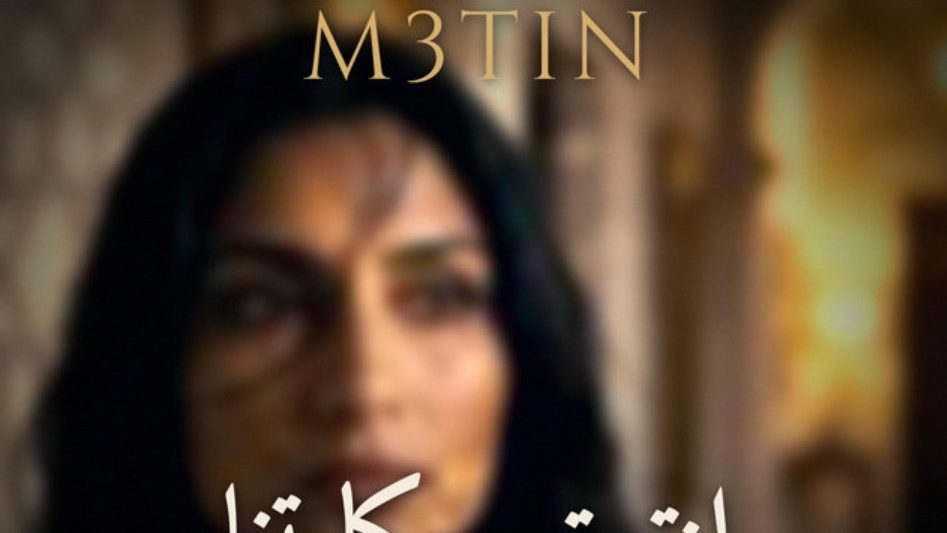
Hello everyone, it’s your host Tehillah from DULAXI, and today I’m delighted to be joined by Ahmet Metin Oktay, songwriter, music architect, and founder of © M3TIN Records. Based in Istanbul, Turkey, Ahmet is the creative force behind M3TIN, an independent project exploring emotionally driven music across languages, cultures, and contemporary production techniques. Today, we are discussing M3TIN’s Arabic single “Intihat Hikayatna”, released on June 26, 2026.
“Intihat Hikayatna” is a Levantine Arabic heartbreak ballad that forms part of a much larger multilingual musical journey, one that approaches language not as a barrier but as another way of allowing a story to find its natural emotional identity.
Before we begin our conversation with Ahmet Metin Oktay, here’s what you need to know about today’s featured project.
About M3TIN
M3TIN is built around an unusual creative philosophy: one artist, many voices, with each song given the opportunity to exist naturally in its own language. Rather than treating multilingual releases as straightforward translations, the project approaches each version as a native adaptation, preserving the same story and melodic heart while allowing the language itself to reshape how that story is emotionally experienced.
At the centre of this approach is Ahmet Metin Oktay, the founder of © M3TIN Records and the songwriter and music architect responsible for the project’s original lyrics and creative decisions. His work brings together emotional songwriting, cinematic production and contemporary studio technology, including AI, while maintaining an open philosophy about how those tools are used. For M3TIN, technology is part of the instrumentarium rather than the author of the work. The artistic decisions, lyrics and emotional direction remain under Ahmet’s authorship.
“Intihat Hikayatna” represents one of the most distinctive chapters in this developing musical story. The song began with a Turkish composition titled “Sayfa Kapandı”, meaning “The Page Is Closed”, but the Turkish original was deliberately left unreleased. Instead, the story was allowed to travel first, beginning with its Kazakh adaptation, “Hikaya Ayaqtaldy”, released in May, before finding its Arabic voice through “Intihat Hikayatna”. The Turkish original is intended to arrive later, in 2027, completing what M3TIN describes as a “homecoming last” approach.
The idea is not to create translated versions that exist beneath the authority of an original recording. Each language is given its own artistic identity. The story, emotional foundation and melodic heart remain connected, but the way those elements are expressed changes according to the language and culture carrying them. Every lyric is confirmed by a native speaker before release, reflecting the project’s emphasis on linguistic authenticity.
For “Intihat Hikayatna”, that process led specifically to Levantine Arabic, drawing on the register associated with everyday emotional expression across places such as Beirut and Amman. The decision proved significant because the same musical material could take on a different emotional character once it entered another linguistic environment. What may feel like resistance in one language can become acceptance in another, even when the melody itself remains unchanged.
The song centres on heartbreak, absence and the quiet aftermath of separation. Its emotional world is not built around an explosive confrontation but around what remains after someone has already left. That idea extends into the visual storytelling surrounding the release, with one cinematic work travelling from a traditional Arab house to the desert and eventually the sea, while another visual treatment uses a mirror to turn the story inward.
The central narrative imagines an Ottoman soldier and the Arab woman he loved. Rather than explaining precisely why their relationship ends, the story focuses on the fact of the separation itself. The house represents the place where their love existed, the desert becomes a space of distance and solitary movement, while the sea becomes the final physical divide between the woman who remains and the ship carrying the man away towards Istanbul.
The Arabic adaptation has also generated considerable organic attention. The wider multilingual campaign has accumulated millions of views, with the Arabic teaser alone surpassing 1.8 million views and the song finding listeners across Egypt, Algeria, Saudi Arabia, Iraq and the wider Arab world. Yet the response has not simply been about numbers. What appears to have mattered most to M3TIN is the extent to which listeners have taken the story and connected it to their own experiences of love, separation and loss.
Having this brief introduction to today’s featured project, I’m sure both new listeners and longtime followers of M3TIN are excited to hear directly from Ahmet. So, without further ado, let’s begin today’s interview.
INTERVIEW SESSION
Tehillah:
“Intihat Hikayatna” arrives with a very specific emotional atmosphere, one that feels rooted in the quiet aftermath of a relationship rather than the dramatic moment of separation itself. When you first imagined this song in its Arabic form, what scene, feeling, or moment did you hear in your mind, and how did that initial image guide the finished recording?
Ahmet Metin Oktay:
An Ottoman soldier and the Arab woman he loved. Not the moment of parting — the room afterwards.
I saw a traditional Arab house at dusk, and a woman alone inside it. He has already gone. No argument, no farewell scene, just how the room looks without him in it.
The recording was built around that. The song never goes back to the moment the door closed. It stays in the quiet that follows, which is where most people actually live a separation.
Tehillah:
The phrase “Intihat Hikayatna” translates to “Our Story Is Over,” which sounds simple, but the word “story” suggests that a relationship is made up of many chapters rather than one event. How did you want the idea of a shared story ending to shape the emotional character of this particular song?
Ahmet Metin Oktay:
An event ends. A story closes. The difference matters.
Calling it «حكايتنا» says that what ended was not one argument but a world the two of them had built — the habits, the private jokes, the way a room smelled. That is where the weight of the song comes from: not the moment that was lost, but everything that had accumulated.
And when a story ends, you do not look for someone to blame. You simply realise you are on the last page.
Tehillah:
Arabic is not one uniform emotional language, and choosing Levantine specifically places this song within a recognizable cultural and conversational world. What did you discover about the emotional personality of Levantine Arabic while developing this version that genuinely changed the way you heard the song?
Ahmet Metin Oktay:
The choice was not mine alone, and I think that matters. I was advised that Levantine suited this melody better than the alternatives, and that it would travel further across the rest of the Arab world than a more localised register. Both turned out to be right.
What I discovered afterwards is why. Levantine lets you be tender without sounding weak — the line stays direct without turning harsh. That was exactly what this song needed, because the separation here is a dignified one: no blame, no pleading.
Working on it, I noticed that the stillness under the melody had read as a kind of resistance in Turkish. In Levantine Arabic it read as acceptance. Same note, different emotion. I did not predict that and I did not choose it. It was pointed out to me, and then I heard it.
I also learned how much I did not know. Levantine is not one thing — Syrian, Jordanian and Lebanese all live inside that word, and this song does not commit to one of them. A few lines sit closer to standard Arabic than to any spoken register. The spirit is Levantine; the execution is not purely Levantine. In hindsight I would have chosen one — Syrian or Lebanese — and written entirely inside it.
Tehillah:
The Arabic adaptation was developed through the Levantine register rather than by simply transferring the original wording into another language. Was there a moment during the process when a completely new Arabic expression or image suddenly made the song feel more alive, even though that idea may not have existed in the original wording?
Ahmet Metin Oktay:
Yes — the cold-night line in the bridge: «اللّي كِنّاه مات بهديك الليلة الباردة» — everything we were died on that cold night.
The «بهديك» is pure Levantine, and the cold-night image is not in the Turkish original in the same way. It arrived inside the Arabic and gave the bridge its ache.
There is another: «صار دخان وطار» — it turned to smoke and flew away. That image feels completely native in Arabic even though it was not carried over from anywhere. Those are the moments you work for. You cannot plan them; the language produces them or it does not.
Tehillah:
A song can retain the same melody while feeling completely different depending on the voice carrying it. What did you want the Arabic vocal performance to communicate about the person at the center of “Intihat Hikayatna,” and what kind of personality did you imagine behind that voice?
Ahmet Metin Oktay:
Someone who has already decided.
I wanted that specifically. Not a voice trying to persuade, not one hesitating, not one leaving a door open. By the time she speaks, she has gone. What she says is not a negotiation — it is a record.
That is harder to perform than it sounds. Showing pain is easy. Showing someone holding pain steady is much more difficult, and much more devastating to hear.
Tehillah:
The musical identity of this release is cinematic, emotional, and nostalgic, yet the subject is intimate enough to work as a deeply personal heartbreak song. How did you decide how large the production should feel, and where did you deliberately keep the arrangement restrained so the emotional core would remain exposed?
Ahmet Metin Oktay:
Arabesk feeling over a cinematic trap foundation. On paper those contradict each other; they work together because neither one takes itself too seriously.
Where I held back is the verses. There is almost nothing there — a voice, some space, a single instrument. So when the chorus opens, it does not feel like a reward. It feels like giving in.
The rule was that the production must never announce what the song feels. It only makes room for feeling.
Tehillah:
One thing that interests me about a multilingual song family is the question of musical ownership: after hearing several versions, a listener may naturally associate the same melody with very different places and voices. What do you think changes when “Intihat Hikayatna” stops feeling like one song translated several times and starts feeling like a song that genuinely belongs to the Arabic listener?
Ahmet Metin Oktay:
When the listener stops asking where it came from.
I have noticed that a song changes ownership the moment someone attaches it to their own life. Most of the Arabic comments do not mention the song’s origin at all. They talk about their own endings.
At that point it is no longer my song. And that is exactly what it was built for.
Tehillah:
The visual journey moves through a house, the desert, and the sea, which are three very different spaces but all carry strong associations with memory and emotional distance. Why were those particular environments important to this song, and what does each one represent within the story?
Ahmet Metin Oktay:
The three settings each carry part of the story.
The house is a traditional Arab house — deliberately not Moroccan, not Gulf, not tied to one region. I wanted it to feel pan-Arab, somewhere any Arab viewer could recognise as home, because the song belongs to all of them rather than to one country.
The desert is where you see her walking alone. It is the space of separation, and of the journey itself.
The sea was a practical decision that became the ending. From an Arab shore, the way to Istanbul is by ship. He is on that ship; she is left on the coast.
Underneath it is the story of an Ottoman soldier and the Arab woman he loved. But the film never explains why it ends. Perhaps he was recalled. Perhaps the empire lost the province he had been posted to. We are not told. All we see is a ship leaving and a woman staying, and that those beautiful days are over.
That was deliberate. The song does the same thing — the reason is never given, because in a real separation the reason rarely settles anything. What remains is the leaving itself.
Tehillah:
The mirror-concept film approaches the song from a more introspective direction, while the other visual work moves through physical landscapes. What different side of the emotional experience did you want each visual concept to reveal?
Ahmet Metin Oktay:
There are two visual treatments.
One lives in the landscapes — the house, the desert, the open space. That is the outer world of the story, where the love actually happened.
The other is built around a mirror. She stands before it and looks at herself. It began as a choreographic choice, but it does something the landscapes cannot: it turns the camera inward. The mirror is where she faces herself — the reflection of the good days that are gone, and the fact that the story has ended.
The landscapes are where the love lived. The mirror is where she admits it is over.
Tehillah:
The Arabic teaser alone surpassed 1.8 million views, while the wider campaign has generated millions of views across several countries. Beyond the numbers, what was the most unexpected way people responded to “Intihat Hikayatna,” whether through comments, interpretations, or the way they connected the song to their own lives?
Ahmet Metin Oktay:
What struck me most was how much the cinematic side intensified the emotion.
I expected people to connect with the song. I did not expect the visuals to pull them in as strongly as they did. People were drawn into it almost as a short film — the whole concept, and the woman at the centre of it, were felt as genuinely beautiful, and that beauty is a large part of why people stayed with the story and let themselves feel it.
The song and the film amplified each other far more than I had anticipated.
Tehillah:
This song has reached listeners across Egypt, Algeria, Saudi Arabia, Iraq, and the wider Arab world, which means the same emotional story is being received across cultures that do not all speak heartbreak in exactly the same way. Did any particular audience response make you rethink an aspect of the song that you had originally considered settled?
Ahmet Metin Oktay:
Yes. The warmest reactions came from North Africa — Algeria especially — along with Iraq and Egypt.
I think that is tied to how enormously popular Turkish television series are across the Arab world, and in North Africa in particular. A great many tourists from there visit Istanbul, and there is real affection for that world. So a song carrying a Turkish-Ottoman emotional atmosphere in Levantine Arabic did not feel foreign to them. It landed somewhere they already knew.
What it made me rethink was my assumption that choosing one dialect would narrow the audience. It did not. Levantine travelled further than I expected, because the emotional world it was carrying had already travelled ahead of it.
Tehillah:
Because the Turkish original remains unreleased, an Arabic-speaking listener encounters “Intihat Hikayatna” without necessarily knowing that another version exists underneath the story. What does that change for you as a creator when you know this audience is meeting the song without being asked to compare it with a “source” version?
Ahmet Metin Oktay:
The Arabic listener meets this song without a hierarchy. There is no “real” version underneath, so this one is not secondary to anything.
I only understood how much that matters afterwards. When an original exists, every adaptation is automatically measured against it — how faithful, how close, how much was lost. With the original absent, that measurement is impossible. The song has to stand on its own.
That feels more honest to me. And when the Turkish arrives in 2027, it will not arrive as the source. It will arrive as the last voice.
Tehillah:
There is a fascinating production philosophy behind M3TIN where contemporary tools, including AI, are openly used while the lyrics, emotional concept, and creative decisions remain under your authorship. For “Intihat Hikayatna” specifically, where did technology help you expand the sound you imagined, and where did your own judgment remain completely decisive?
Ahmet Metin Oktay:
Technology widened the texture — the space under the arabesk strings, the breath in the trap foundation. It works on the how.
What it could not decide was the dialect. Levantine, Egyptian, Gulf — that is not a question of sound, it is a question of belonging. Every person I consulted gave me a different answer, and each was certain. No tool resolves that, because there is no correct answer. There is only an owned choice.
The same is true of accent. In Arabic the long vowels expose an accent mercilessly — a single sustained sound can give away an entire phrase. That is the place where technology gets close and cannot finish. There the human ear takes over, and that ear is not mine. It belongs to native speakers.
Tehillah:
The campaign has made “Intihat Hikayatna” one of the more visible chapters in this multilingual story, but the song itself remains fundamentally about an ending between two people. After spending so much time developing its language, sound, and visual world, what part of the original emotional experience still feels most fragile to you?
Ahmet Metin Oktay:
The bridge. «اللّي كِنّاه مات بهديك الليلة الباردة» — everything we were died on that cold night.
That line was born in Arabic. It did not exist in the Turkish. And that is precisely why it feels fragile: I did not plan it. It came out of the language.
Every time I hear it, I feel that the rest of the song exists to protect that one line. My fear is that someone will one day sing it wrong.
Tehillah:
Unlike a song that simply tells listeners how to feel, “Intihat Hikayatna” leaves room for the audience to insert their own memories into the ending. What do you think people hear in a heartbreak song when they are no longer listening only for the artist’s story, but quietly comparing it with their own?
Ahmet Metin Oktay:
Their own voice.
If a breakup song is specific enough, people substitute their own story into it. The details do not match — they had no cold night, it is not the room I described — but the emotional shape does.
The most powerful message I receive is not “I like your song.” It is “this is my story.”
When that sentence arrives, the listener is no longer hearing my story. They are hearing their own, once more, but from the outside this time. I think that is the most useful thing music can do.
Tehillah:
This Arabic chapter now exists as its own complete artistic experience, while the wider story continues moving through other languages and eventually toward the Turkish homecoming. Having seen what “Intihat Hikayatna” has become on its own, what new possibility has this song opened for the future of M3TIN’s approach to storytelling across languages?
Ahmet Metin Oktay:
It showed me that a language can host a story completely — not accommodate it, but own it. And it showed me where my own process was too thin.
This was my first Arabic adaptation, and I relied on a single reviewer. For a register as broad as Levantine, one voice cannot settle it. The upcoming Arabic work is built differently: several native readers from different parts of the region, and the dialect decided before a line is written rather than discovered afterwards.
The next Arabic single is a deliberate answer to that. It is another adaptation from the same Turkish family, and it will be in Egyptian Arabic — chosen because Egyptian carries a single, clear centre. It is understood across the whole Arab world, and there is no ambiguity about which region it belongs to. Levantine asked me a question I had not prepared for. Egyptian does not ask it.
That also opened a larger idea: why only one Arabic at all? Gulf and Maghrebi could carry the same story with entirely different emotional weather. Adaptation within a single language, not only across languages.
A second Arabic adaptation is sitting in the studio right now, unresolved for exactly that reason. I would rather leave it unreleased than release something that belongs to nobody.
“Intihat Hikayatna” is where a story about one ending becomes something much larger: a meditation on how music changes when language, memory, place, and personal experience give the same emotional core a new home. M3TIN’s approach makes the listener part of that journey, allowing the song to arrive not as a translated memory, but as something capable of becoming their own.
~ Tehillah (DULAXI Team)
EDITORIAL PERSPECTIVE
What stayed with me most about “Intihat Hikayatna” is the discipline behind its emotional restraint. The sparse verses, cinematic atmosphere and controlled vocal character allow the central story to unfold without forcing its sadness onto the listener. More importantly, the multilingual concept gives the song another dimension, showing how a melody can acquire a different emotional identity when placed inside a new linguistic world. Ahmet’s openness about both the creative process and its limitations makes the project particularly compelling.
~ Tehillah (DULAXI Team)
CLOSING
Our conversation with Ahmet Metin Oktay offers an illuminating look at the ideas behind “Intihat Hikayatna” and the wider creative world of M3TIN. From the imagined Ottoman soldier and Arab woman at the centre of the story to the decision to let the Turkish original remain unreleased until the final stage of the journey, every part of the project is connected to a broader question about how stories travel and how music finds belonging.
Thank you to Ahmet for taking the time to speak with DULAXI and for sharing such thoughtful insight into the writing, Arabic adaptation, production, visual concepts and philosophy behind M3TIN. His reflections reveal not only the emotional thinking behind this particular release, but also the evolving process through which the project continues to develop its multilingual approach.
For readers discovering M3TIN through this interview, “Intihat Hikayatna” offers an opportunity to experience the Arabic chapter of this story on its own terms, while the wider catalogue provides a fascinating look at how one emotional idea can take on new character across languages and cultures.
Thank you for spending time with DULAXI. We hope this conversation encourages you to listen more closely to “Intihat Hikayatna”, explore M3TIN’s expanding body of work, and follow where this multilingual musical journey goes next.
Until our next interview, this is Tehillah from the DULAXI Team.