
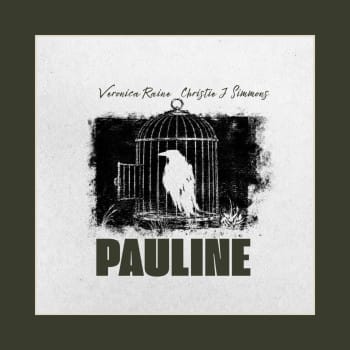
Veronica Raine and Christie J. Simmons’ “Pauline,” released on 23 October 2026, is an original single that brings two Southern Alberta songwriters together around a story of confinement, habit and the unsettling moment when an open door no longer leads anywhere. Set in folk, singer-songwriter and country territory, the track opens with a solo electric guitar lick before the acoustic guitar, bass and drums enter, and that twangy introduction grabs attention at once through its instrumental arrangement, melody and rhythm. The vocal that follows is warm, rich and smooth, and its crisp tone keeps every line of the story clear. Across a running time of 3:38, the song covers decades of one woman’s life, and its moderate, balanced pacing gives that storytelling room to settle.
The story belongs to Pauline, and the writing follows her across decades with unusual economy. She first appears as a reckless, naive eighteen-year-old spending her nights in dimly lit clubs, and the narrative carries her to the life of a forty-year-old woman shaped by long years behind prison fences. Between those two points, choices and circumstance tangle with denial and truth, so months turn into years without a clear moment at which she could have turned back. A caged-bird motif holds the whole story together: the clipped wings, the invitation to build a nest right where she is, and the third-verse turn in which the cage is finally opened and she remains trapped inside. The song raises the question of whether denial or the truth is the heavier burden, and it leaves that question open for listeners to answer for themselves. Storytelling is the strongest feature of the lyrics, and sustaining one image from the earliest lines to the third verse gives the narrative a tightness that suits a song of just over three and a half minutes.
The vocal performance carries that story with conversational ease. The first impression is captivating and distinctive, a voice that is warm, rich and full-bodied while staying smooth and crisp, and the delivery blends storytelling with a soulful, passionate pull. Control matters here: the singing stays reflective and measured, so the passing of decades is told as plain narration instead of melodrama. Around the 2:31 mark the arrangement strips back and tension gathers, leaving the vocal in the spotlight, and the tender, intimate delivery in that passage is where the song feels most personal. The expressive phrasing then escalates toward the final chorus, which is the emotional peak of the performance and the point at which the closing realization about the open cage is delivered with the most force.
That tension is shaped by an instrumental arrangement that is balanced, richly layered and organic, with an atmospheric quality that never crowds the voice. The twangy electric guitar opening and the expressive solo give the track a gritty edge, and across the song the guitar work is melodic and rhythmic at once, textured, driving and emotive, while the acoustic guitar keeps the folk foundation in view. The bass is deep, warm and punchy, with tight, driving lines, and the drums are tight, controlled and groovy, with enough force and dynamic range to drive the song without overwhelming the vocal. Synthesizer and keyboard parts sit in the background, contributing warmth and texture. Because the instruments carry the melody, support the vocal and drive the rhythm, they also help shape the storytelling, adding tension, releasing it and setting one section against another so that the song’s contrasts register clearly.
The production is clean and polished, and that clarity keeps every layer distinguishable so the narrative stays in front. The most revealing moment in the lyrics is the third-verse turn, when the cage opens and nothing changes. The line “needed a roof and not the sky” explains why: after years inside, shelter has become the only thing she recognizes, and open air offers no comfort. That is the point at which her story shifts from imprisonment to institutionalization, because the walls are no longer needed to hold her. The final chorus lands as the climax because the arrangement has already narrowed its focus to the vocal, and when it fills out again the tension of the stripped-back passage is finally released. Themes of separation, loneliness, aging and dreams that never take root run through the story, and its questions about freedom, justice and humanity extend it beyond a single character into a wider observation about how circumstances can outlast the confinement that created them.
The collaboration joins two songwriting voices with distinct strengths. Veronica Raine is a Southern Alberta indie folk singer-songwriter known for emotionally honest lyricism and intimate, story-driven performances; she began writing music at thirteen on the ukulele before moving to guitar, and her debut single “august” earned radio play across Canada and has been featured on SiriusXM and CBC Music. Her music has been championed by more than 80 radio stations worldwide, and in 2026 she has appeared at the Winnipeg Folk Festival, Tongue on the Post and East Town Get Down. Christie J. Simmons crafts elegant acoustic songs that balance clarity with poetic edge, drawing on a background in classical flute, early music and highland bagpipes, and her albums Winnie’s Song and Learn You by Heart reflect a gift for quiet intensity. Mark Troyer produced and engineered the recording and also performs on it, with Mitch Jay credited on slide guitar. Both writers share songwriting and performing credit, and the plain, precise storytelling of “Pauline” reflects the clarity and honesty each is known for.
Pauline Traces A Life Behind Prison Fences And Asks What Remains Of Freedom When The Cage Door Finally Opens.
~ Daniel (DULAXI Team).
What lingers after the final chorus is reflection, and the song earns it by leaving the open door unresolved. I can imagine “Pauline” working best in quiet settings such as personal reflection, night-time listening, headphones, relaxing at home or a drive, where the details of the vocal and the storytelling can be followed closely. Listeners who value emotional storytelling, lyrical songwriting, introspective music and lyrics worth reading closely will find plenty to follow here, and fans of alternative, rock and pop music may find an entry point in the polished arrangement. Veronica Raine and Christie J. Simmons deserve appreciation for the originality of the song’s central image, the quality of the songwriting and storytelling, the vocal performance, the arrangement and the artistic vision behind it, and the most fitting encouragement is to keep telling authentic stories through music, to stay true to their artistic identity and to keep sharing songs that connect emotionally.
For more information about Veronica Raine and Christie J. Simmons, click on the links below.