
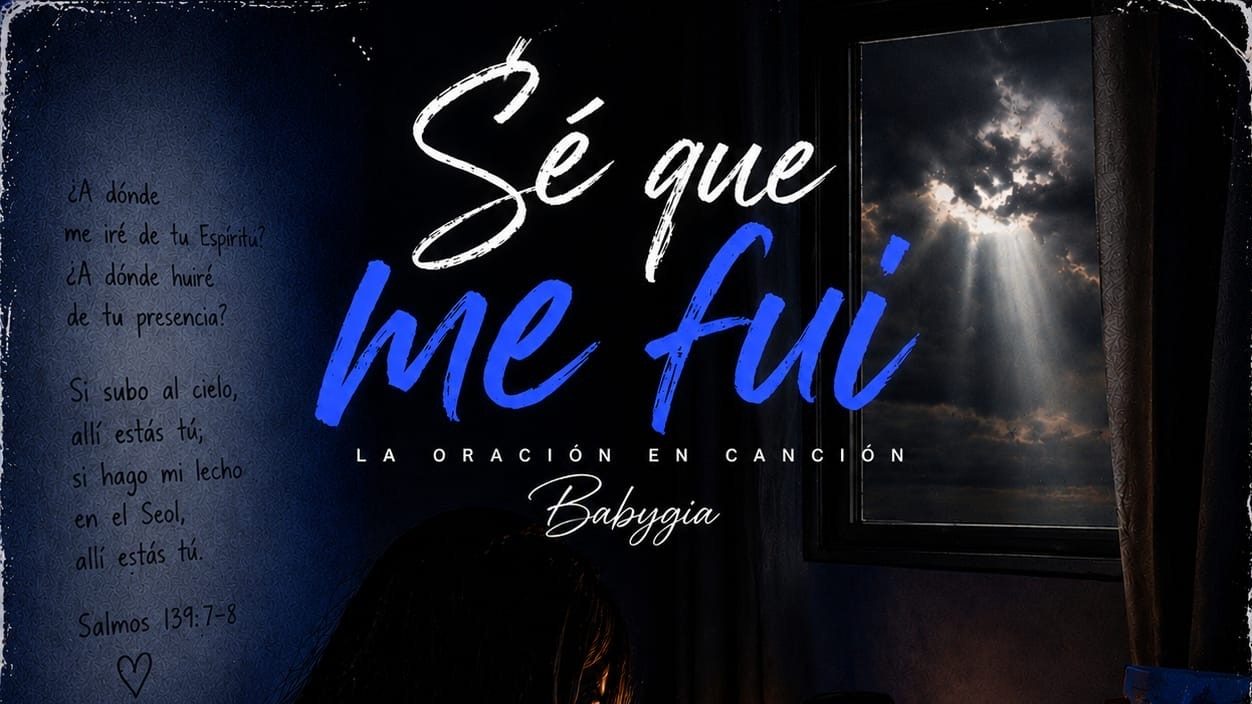
Released on 11st August 2026 in Las Palmas de Gran Canaria, Spain, “Sé que me fui” presents BABYGIA in an unusually exposed state, turning songwriting into an act of spiritual confrontation rather than a conventional pop performance. The song began as a letter to God during a period of spiritual disconnection, and that origin shapes everything about its emotional character. BABYGIA does not sing from a position of certainty; she communicates the discomfort of someone who knows she has drifted but still believes the person she is addressing remains present. Her breathy and delicate vocal delivery gives the performance an almost private quality, with every hesitation carrying emotional significance. Rather than projecting strength, she allows fragility to remain audible. The lyrics move through doubt, gratitude, surrender, abandonment and the desire for restoration, creating a deeply personal portrait of faith under pressure. Her voice becomes the emotional centre because it never separates the singer from the struggle being described.
The most compelling element of “Sé que me fui” is its refusal to turn spiritual uncertainty into an easy resolution. BABYGIA explores what happens when someone feels disconnected from something that once provided direction, admitting the confusion and exhaustion that accompany that distance. The lyrics frame faith as something she is actively trying to recover rather than something she possesses without question. Her delivery makes this conflict especially powerful: she sounds restrained, intimate and emotionally tired, yet there is still a clear desire to reconnect. The central themes of being lost, feeling abandoned and searching for redemption give the song a broader emotional reach beyond its specifically religious subject. Anyone who has experienced distance from something once deeply meaningful can understand its sense of searching. The closing spoken passage intensifies that honesty, as BABYGIA abandons the structure of singing and simply acknowledges that she no longer knows what to say before asking for help to love God again. That moment transforms the song from reflection into direct supplication.
Musically, “Sé que me fui” deliberately gives BABYGIA enough space for that vulnerability to remain undisturbed. Its contemporary pop-ballad foundation relies on soft ambient synth pads, subtle percussion and restrained melodic details rather than a crowded arrangement. This minimalism is important because the production never competes with the emotional content of the vocal. Instead, the sparse instrumentation creates a hollow, spacious environment that mirrors the sense of internal emptiness contained within the song. Reverb and spatial effects place BABYGIA inside a wide soundscape, giving her voice both closeness and loneliness at once. The result sits comfortably between modern bedroom pop and devotional soul, but its identity comes from the balance between polished production and emotional rawness. There is a melancholic progression throughout the arrangement, although the music never becomes completely hopeless. Its restraint creates tension without requiring dramatic instrumental escalation, allowing the emotional weight to accumulate naturally as the song unfolds.
The structure ultimately becomes one of BABYGIA’s most meaningful artistic decisions. “Sé que me fui” avoids a traditional repetitive chorus, choosing instead to develop continuously like a diary entry, private conversation or unfolding prayer. That approach makes the song feel immediate because its thoughts are not packaged into predictable cycles; they develop as an emotional stream. The absence of a conventional chorus also reinforces the uncertainty at the heart of the writing, since the song is not trying to deliver a simple conclusion. The instrumentation follows this philosophy by remaining understated while the vocal carries the narrative forward. By the final moments, the spoken passage strips away the remaining distance between performer and subject, leaving behind an admission of uncertainty and a plea for renewed love and faith. BABYGIA therefore turns “Sé que me fui” into more than a song about spiritual distance: it becomes a document of someone standing inside that distance and honestly asking for a way home.
“Sé que me fui” Transforms Spiritual Distance Into An Honest Search For Redemption, Surrender, Renewed Faith, And The Courage To Ask God For Help.
~ Daniel (Dulaxi Team)
BABYGIA is an independent Peruvian artist based in Spain, developing her musical identity through honest storytelling, intimate songwriting and emotional vulnerability. As both a songwriter and vocalist, she transforms personal experiences, difficult emotions and questions that are difficult to express in ordinary conversation into music that feels direct and deeply personal. Her sound moves between urban pop and Latin influences, while her writing remains centred on emotional storytelling and genuine human experiences. BABYGIA takes an active role in writing, recording and shaping her releases, allowing her emerging project to grow with a clear sense of artistic ownership and purpose. That independence connects naturally with the openness of “Sé que me fui,” where she turns personal uncertainty into an affecting musical experience. The track stands as a strong introduction to her artistry, and its sincerity, vulnerability and restrained beauty make it well worth giving your full attention.